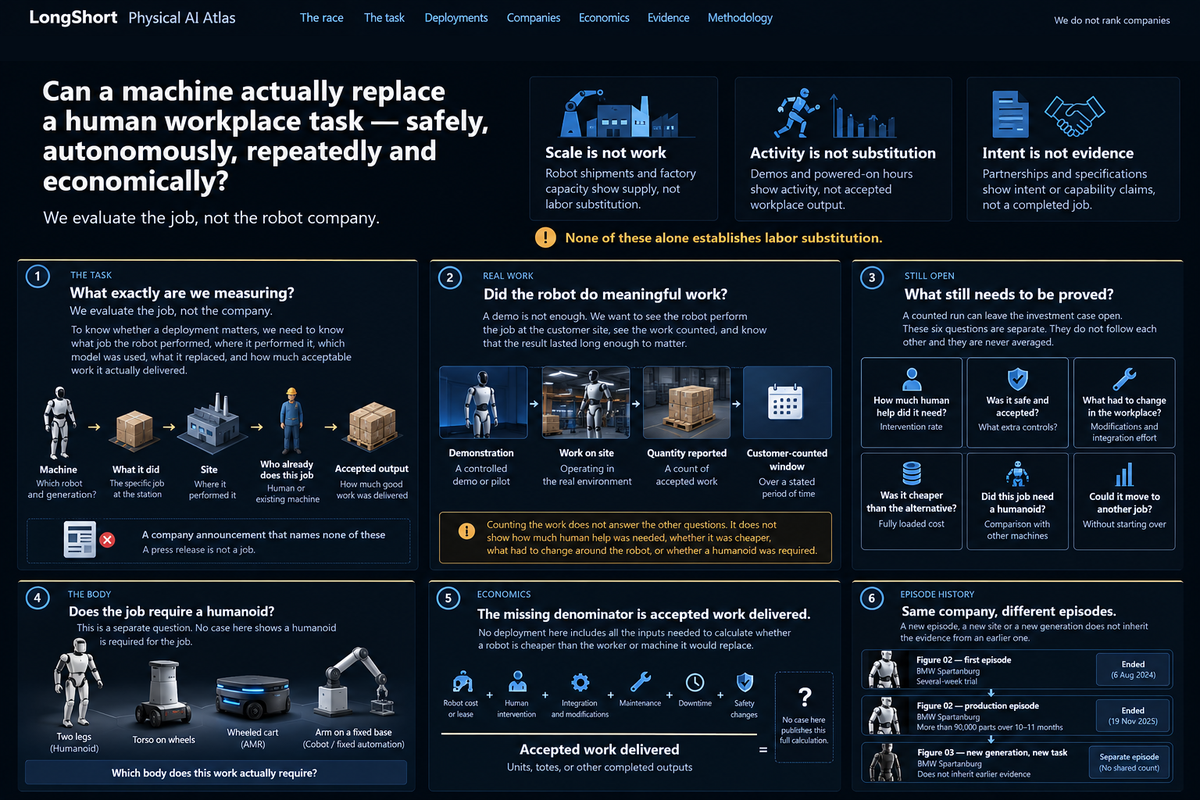
Can a machine actually replace a human workplace task — safely, autonomously, repeatedly and economically?
We evaluate the job, not the robot company.
More robots built does not mean more work replaced
Shipments and factory capacity tell us how many robots exist — not how much human work customers have actually replaced.
More hours running does not mean less human labor
A demo or long runtime shows the robot was active. It does not tell us how much acceptable work it completed or how often people still had to step in.
A partnership does not prove the job works
Contracts, pilots and specifications show intent. They do not prove the robot performed the job successfully in production.
What matters instead
How much accepted work did the robot deliver, how much human help did it still need, and what did that work cost?
Machine
What it did
Site
Who already does this job
Accepted output
A company announcement that names none of these
What would change the conclusion. A customer count of accepted work, how often a person stepped in, and the full cost of that work.
What has to be known
Did the robot do meaningful work?
Demonstration
Work on site
Quantity reported
Customer-counted window
Counting the work does not answer the other questions.
What is still unknown
One thing is proven. Six important questions remain open.
EstablishedCustomer-counted production work. Figure 02 at BMW Spartanburg, 2025. More than 90,000 parts.
UnresolvedHow often did a person step in?Human intervention.
UnresolvedWas it safe and accepted?Controls / safety.
UnresolvedWhat had to change in the workplace?Integration.
UnresolvedWas it cheaper than the alternative?Fully loaded economics.
UnresolvedDid the job need a humanoid?Embodiment.
UnresolvedCould it move to another job?Transfer.
Two-legged humanoid
Torso on wheels
AMR / wheeled cart
Fixed arm / cobot cell
The question is not whether a humanoid can perform the job. The question is whether the job needs a humanoid when simpler machines are considered on the same work.
What has happened
Each heading is the conclusion. Companies are not ranked.
Figure 02 — first trialEnded · 6 Aug 2024
Figure 02 — later production runEnded · 19 Nov 2025
Figure 03 — new generation, new jobNo inherited evidence
Evidence belongs to a deployment. A new generation, job, site or episode does not automatically inherit an earlier result.
Digit at GXO — commercial deployment, economics still opaque
Paid deploymentEconomics unknown
Digit is in paid commercial use at GXO, and there is still no public basis for a labor-saving claim. Since a June 2024 service agreement it has moved totes from a cobot onto a conveyor at Flowery Branch. Agility has reported 100,000 totes and, in September 2026, still described the site as active. The customer has not published that count over a stated period, and the record does not say how often a person stepped in. Without that labor figure, the service fee does not show how much work a person stopped doing, or whether Digit is cheaper. The station around the robot was changed. The cost of that change is not in any comparison. A 65,000-hour total names other customers and is not this site.
Status detail
Real production work
Vendor-reported. Not counted by the customer over a stated period.
Human intervention
Not publicly known. Without it, labor replaced cannot be measured.
Customer acceptance
Service agreement in place. The controls around the robot are not disclosed.
Economics
Not established. A fee was agreed. A cost comparison was not.
Humanoid advantage
Not established. Other machines in the building do a different move.
Figure 02 at BMW, 2024 — the trial ended without a part count
The 2024 BMW trial cannot support a labor-saving claim. It ended by 6 August 2024 with no part count, no Figure robots left at Spartanburg, and no timetable. Nothing from it carries into the 2025 run.
Status detail
Real production work
Not established. The job was reported. The volume was not.
Human intervention
Not publicly known.
Customer acceptance
The trial ended. No robots remained on site.
Economics
Not established. There is no volume to price.
Humanoid advantage
Not established.
Transfer to another job
Not established. This trial does not carry into 2025.
Figure 02 at BMW — sustained production work, economics still unknown
Production work demonstratedEconomics unknown
Figure 02’s BMW run is the strongest evidence in this set of sustained factory work, and it still does not show a labor saving. The robot moved more than 90,000 sheet-metal parts onto a weld fixture at Spartanburg. Figure dates the run at eleven months; BMW dates it at ten. Both state the count. The run then ended, and the robots were returned when that model was retired. BMW kept the robot on the line with added barriers and partitions. The record does not say how often a person had to step in. Without that number, together with maintenance, downtime, and the cost of those changes, the part count does not prove a saving. No other machine has been measured on this same placement. The welder does the next step, not this one. Figure 03 is a newer robot on a different job.
Status detail
Real production work
Established. More than 90,000 parts over the stated months.
Human intervention
Not publicly known. Stated cycle time, accuracy, and zero-intervention targets are goals, not results.
Customer acceptance
Established for this run, with additional barriers and partitions.
Economics
Not established. The cost of the person, the interventions, and the station changes is not published.
Humanoid advantage
Not established. No other machine was measured on this placement.
Transfer to another job
Not established. Figure 03 does not inherit this result.
Figure 03 at BMW — a demonstration, not production evidence
Demonstration
Figure 03 is a plant demonstration, not production evidence and not a cost result. On 30 June 2026 Figure showed it on site in Hall 52. Picking, placing, and pulling a cart are described together, and no count was published. That a fixed machine cannot do the job is a company assertion that has not yet been supported by a same-task comparison. The Figure 02 part count does not carry over.
Status detail
Real production work
Not established. This was a demonstration.
Human intervention
Not publicly known.
Customer acceptance
Not established as ongoing production use.
Economics
Not established. There is no volume to price.
Humanoid advantage
Not established. A company assertion that a fixed machine cannot do the job has not been supported by a same-task comparison.
Transfer to another job
Not established. This is a new robot and a different job.
HMND at Siemens — a rate was met, in a two-week proof of concept
Proof of concept
The Siemens trial does not support a labor-saving claim. A wheeled HMND 01 destacked totes onto a conveyor at Erlangen during a two-week trial that has ended. The reported rate was 60 moves an hour, described as the target met, with uptime above eight hours and a success figure above 90 percent. The number of attempts behind that percentage is not stated, and no tote count was published. A short rate, without accepted volume and without a count of human help, cannot be turned into a wage saving. The result says nothing about a two-legged robot on a different job.
Status detail
Real production work
Not established. A rate was reported. A tote count was not. The trial ended.
Human intervention
Not measured. The success rate has no count of attempts.
Other machines at GXO — already working, on a different job
Machines already in the GXO building do not show that Digit’s job required a humanoid, and they do not price that job. Wheeled carts and a cobot were moving material at Flowery Branch when Digit arrived. They were not shown doing Digit’s placement onto the conveyor.
Status detail
Real production work
Described for their own move. Not counted. Not Digit’s job.
Human intervention
Not publicly known for this move.
Customer acceptance
They were already operating. Later detail was not published.
Economics
Not comparable with Digit. The jobs differ.
Humanoid advantage
Not answered. These machines do not do Digit’s placement.
AGIBOT at Longcheer — hours on the line, accepted work and price unpublished
Economics unknown
Longcheer does not support a labor-saving claim: the customer reported hours, not acceptable tablets, and did not state a price. From 16 March to 15 April 2026, AGIBOT’s G2 handled tablets at a test station in Nanchang. Taking a tablet from the conveyor, fixturing it, and sorting it were not counted separately. On 15 April the customer reported more than 200 hours and the vendor reported more than 140. Both figures stand. Neither is a count of acceptable tablets. The customer said the relationship was not a robot purchase. The station was changed for the robot. That cost is also unpublished.
Status detail
Real production work
Not established. Hours were reported. A tablet count was not.
Human intervention
Not known for the month. Downtime is not a count of people stepping in.
Customer acceptance
The campaign window is published. The controls are not.
Economics
Not established. The customer said this was not a purchase. The price is unstated.
Longcheer, 14 April 2026 — one shift with no intervention, not the month
One shift without a person stepping in does not show that the month at Longcheer replaced labor, and it does not create a cost. The customer said that on 14 April 2026 an eight-hour run had no person step in. That result covers the shift, not the month, and it is not a count of tablets.
Status detail
Real production work
Not established. The figure is eight hours present, not tablets accepted.
Human intervention
None reported for this shift. Not measured for the month.
Customer acceptance
Reported for the shift only.
Economics
Not established. This shift does not price the campaign.
Apollo at Mercedes — data collection, not production work
Apollo at Mercedes was data collection under human control, not production work and not a cost result. On 18 March 2025, employees collected data by teleoperating the robot in a production environment in Berlin. Transport and quality checks were named as things the robot might do. They were not reported as jobs performed. A later Apollo model does not update this case. An equity stake in the company is not this job.
Status detail
Real production work
Not established. The work shown is data collection under human control.
Human intervention
The work was teleoperated. A person was in the loop.
Customer acceptance
Continued production use is not disclosed.
Economics
Not established. There is no production comparison to price.
Humanoid advantage
Not tested.
Transfer to another job
Not established. Named capabilities were not opened as jobs done here.
Atlas at Hyundai — training today, not line production
Training
Atlas at Hyundai is in training, which is not line production and not a saving. On 21 September 2026 Boston Dynamics described the Metaplant training center as operating. The work is training on parts sequencing. Teleoperation, simulation, and another teaching method are named. Their shares are not measured, so the labor still involved is unknown. A plan for how many robots a future factory will hold is not this result.
Status detail
Real production work
Not established. Training is not line output.
Human intervention
Not measured. Several teaching methods are described. Their shares are not.
Customer acceptance
The center was operating. That is not acceptance of line work.
Atlas on the line — planned for 2028, not yet performed
Planned
There is no cost conclusion on the 2028 line job, because Atlas has not done it. Parts sequencing at the Hyundai plant is a plan. Until the robot does that job, there is no accepted work to count. The training center does not carry forward.
AGCO sorting — contracted for 2027, not yet performed
PlannedEconomics unknown
The AGCO sorting contract is not evidence of labor saved: the work has not started and the price is not stated. The agreement is dated 20 October 2026. A pilot that would sort and stack parts at Hesston is expected in 2027. Putting totes away at the same plant is a separate job.
Status detail
Real production work
Not started.
Human intervention
Not started.
Customer acceptance
An agreement exists. Use has not.
Economics
Not established. The price is unstated, and there is no work to compare.
Humanoid advantage
Not started.
Transfer to another job
Not started. Tote placement at Hesston is a separate job.
AGCO tote placement — same contract, a different job, also not started
Tote placement at AGCO cannot be costed yet, and Digit’s results at GXO do not apply. The job is named in the same 20 October 2026 agreement and has not started. Until the pilot runs, there is no accepted work to compare.
Status detail
Real production work
Not started.
Human intervention
Not started.
Customer acceptance
Named in the agreement. Not yet in use.
Economics
Not established. The price is unstated.
Humanoid advantage
Not started. The GXO result does not carry over.
Transfer to another job
Not started. Sorting at Hesston is a separate job.
Labor savings are being discussed before they can be calculated.
The missing denominator is accepted work delivered.
No deployment in the current public evidence set provides enough information to calculate fully loaded labor substitution. A service agreement is not proof of savings. A robot purchase is not proof of savings. A runtime figure is not proof of savings. A work count is not proof of savings.
The record is missing, in one comparison, human intervention, the robot’s commercial cost, maintenance, downtime, integration, safety changes, and accepted output. Where an input is absent, the comparison is not made. No wage, return, or payback is estimated here.
Robot cost / lease
Human intervention
Workplace integration
Maintenance
Downtime
Safety changes
divided by
Accepted work delivered
=
Not yet calculable from the public record
The relevant comparison is not robot price versus wage. It is the fully loaded cost of accepted work.
No deployment here publishes those inputs together. A service contract, an agreement with no stated price, and a statement that the relationship was not a purchase show a commercial relationship. They do not show the robot is cheaper than the person or the machine it would replace.
Evidence
The notes below are the record behind the conclusions. Each one says what was shown, what that supports, what it does not support, and what would change the call. The research classification used for audit is under Research state.
Digit at GXO
What has been shown. GXO, 27 June 2024, named the job and a robots-as-a-service agreement. Agility, 15 September 2026, stated 100,000 totes and about 98 percent accuracy while on task, and still described the site as active.
What it establishes. The job was performed, a company quantity exists, and a payment form exists.
What it does not establish. That the customer counted the totes over a stated period, how often a person stepped in, whether it was cheaper, or that a human-shaped body was required. A 65,000-hour total names other customers and is not this job.
What would change the assessment. The customer counting the totes over a stated period, a count of how often a person stepped in, or a cost comparison with another machine doing this same job.
Research state
OP2 Quantified. Economics unproven. Payment without comparison. Autonomy unproven. Embodiment comparison inadmissible. Not operationally closed.
Figure 02, the trial that ended by 6 August 2024
What has been shown. BMW described a trial of several weeks and then said no Figure robots remained and there was no timetable.
What it establishes. The placement job was reported by the customer, and that trial ended.
What it does not establish. How many parts were moved, how much human help was needed, whether it was cheaper, or anything about the 2025 run.
What would change the assessment. A count from that trial. It has not been published.
Research state
OP1 Attested. Autonomy unproven. Not operationally closed.
Figure 02, the 2025 run
What has been shown. Figure, 19 November 2025: more than 90,000 parts, an eleven-month window, more than 1,250 hours, and the robots returned. BMW’s later account: ten months, the same parts count, and additional barriers and partitions. More than 30,000 X3s are line context.
What it establishes. For this robot, at this plant, during this run, the customer counted the parts over a stated period. The customer also kept the robot on the line with extra barriers.
What it does not establish. That it worked without human help, that it was cheaper than the person it stood in for, that the body had to be human-shaped, or that Figure 03 can do another job. Cycle time, accuracy, and “zero interventions” in the source are targets, not results.
What would change the assessment. An intervention study, a full cost comparison, or a second machine measured on this same placement.
Research state
OP2 Quantified. Operationally closed. Economics unproven. Autonomy unproven. Embodiment comparison absent. Safety and acceptance: accepted with added controls. Integration required and described. Task transfer: single task.
Figure 03 demonstration
What has been shown. Figure, 30 June 2026: an on-site demonstration in Hall 52. The company says the manipulation is structurally infeasible for fixed automation.
What it establishes. The company showed the robot at the plant. The description mixes picking, placing, and pulling a cart, and does not split them.
What it does not establish. A count of the work, continued use, how much human help was needed, a cost, or that this body was necessary. That a fixed machine cannot do the job is a company assertion that has not yet been supported by a same-task comparison.
What would change the assessment. A customer count, or a recorded trial of another body on the same actions.
Research state
OP1 Attested. Embodiment hypothesis only. Inherits nothing from Figure 02.
Siemens Erlangen
What has been shown. Humanoid, 15 January 2026, and Siemens, 16 April 2026: a two-week proof of concept, 60 tote moves an hour described as achieved, uptime above eight hours, autonomous success above 90 percent.
What it establishes. A wheeled machine did this job for a short trial, and a rate was reported.
What it does not establish. How many totes were moved, how often a person stepped in, whether it was cheaper, or anything about a two-legged robot.
What would change the assessment. A count over the stated two weeks, and the number of attempts behind the success rate.
Research state
OP2 Quantified as a target-met rate. Autonomy claimed, not measured. Not operationally closed. Episode ended.
GXO AMR and cobot
What has been shown. GXO, 27 June 2024, described those machines on their own upstream move, beside the Digit placement job.
What it establishes. Other machines were already doing different work in the building.
What it does not establish. That a humanoid is unnecessary for Digit’s placement.
What would change the assessment. One of those machines performing the cobot-to-conveyor placement, with its own count.
Research state
OP1 on their move. OP0 on Digit’s placement. Comparison inadmissible.
Longcheer campaign
What has been shown. Longcheer and AGIBOT, both 15 April 2026. Hours disagree: more than 200 and more than 140. The customer said the relationship was not a robot purchase.
What it establishes. The campaign happened, and the two hour figures must both be kept.
What it does not establish. A tablet count, campaign autonomy, or a price.
What would change the assessment. A customer count of tablets over the stated window, and a stated consideration.
Research state
OP2 Quantified on disagreeing hour measurements. Not operationally closed. Economics: contracted, consideration unstated. Autonomy unproven for the campaign.
Longcheer eight-hour run
What has been shown. Longcheer: on 14 April 2026, an eight-hour run with no human intervention.
What it establishes. For that eight hours, the customer says no person stepped in.
What it does not establish. That the whole month ran that way, or that the customer counted the tablets over a stated period.
What would change the assessment. The same intervention result across the campaign, plus a tablet count.
Research state
Autonomy measured for this episode only. The campaign remains autonomy unproven.
Apollo in Berlin
What has been shown. Mercedes-Benz, 18 March 2025: employees collected data with Apollo by teleoperation in a production environment.
What it establishes. Teleoperated data collection occurred.
What it does not establish. That the robot did production work on its own, or that it was cheaper. Owning a stake in the company is not this job.
What would change the assessment. A later document would have to name this same robot generation doing this same job. A newer generation does not update this case.
Research state
OP1 Attested. Autonomy: teleoperated.
Atlas training center
What has been shown. Boston Dynamics, 21 September 2026: the training center is operational, and the work described is training on parts sequencing.
What it establishes. Training, not line production.
What it does not establish. The 2028 line job, how much of the work was done without a person, or a claim about how many robots a future factory will hold.
What would change the assessment. Someone actually watching the line job, recorded as its own case.
Research state
OP1 Attested. Training is the work-unit. Autonomy mixed and unmeasured.
Atlas line job from 2028
What has been shown. A plan, not a performance.
What it establishes. We can name the future job.
What it does not establish. That the robot did the job, that accepted work was counted, or that intervention, cost, or the need for a humanoid is known.
What would change the assessment. This robot doing this job at this plant.
Research state
OP0 Unobserved. Not yet testable.
AGCO Hesston, two future jobs
What has been shown. Agility, 20 October 2026: an agreement covering a planned pilot, with sort-and-stack and tote placement as distinct jobs. Consideration unstated.
What it establishes. Two named jobs, and a contract with no published price.
What it does not establish. That any work has been done, how much human help it will need, whether it will be cheaper, or anything carried over from GXO.
What would change the assessment. The pilot actually doing one of those jobs, recorded only on that job.
Research state
OP0 Unobserved on both paths. Economics: contracted, consideration unstated.
Methodology
Where two sources disagree, both figures are kept. A later robot, a later job, or a later plant does not inherit an earlier result. A counted run means this generation did this job at this site, at production scale, over a period the customer or an independent source states. That count does not mean the robot worked alone, cost less, was safe in general, had to be a humanoid, or can take another job without starting over. Companies are not ranked. The internal classification sits under Research state. It is the audit record.
Physical AI Atlas sits beside the Critical Minerals Atlas and the Quantum Atlas. They do not share a research model. The shared idea is to discover the structure beneath the narrative.